
Essay
Crossing Codes – zur Rhetorik des »Adbust«
Wie Plakate per Umgestaltung ihre Wirkung verändern
1 Adbusts
Ausgangspunkt meiner Faszination für die Möglichkeiten der Umgestaltung von Werbeplakaten war dieses Plakat (Abb. 1):
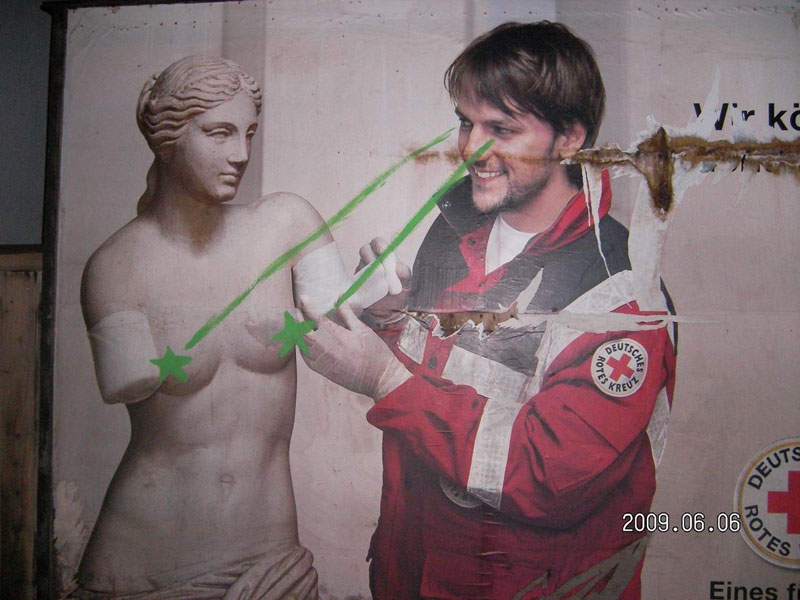
Abbildung 1
Ich sah es zufällig 2009 in Jena, fotografierte es und wollte es verstehen. Was verändern die beiden Linien, die, mit schneller Hand und aller Wahrscheinlichkeit nach vollkommen unbedacht, in dieses schon damals halb verwitterte Werbeplakat eingezogen wurden, die Botschaft des Plakates? Weitere dieser sogenannten »Adbusts« sind reichlich im Internet zu finden (Abb. 2 bis 5).

Abbildung 2

Abbildung 3

Abbildung 4

Abbildung 5
Diese Bilder sind nicht zurückführbar – das ist meine These – auf eine einzige Strategie, »einen Code zu crossen«, wie es in der Graffiti-Sprache heißt. Warum aber und wie funktionieren diese Brechungen von Sinn? Auf die Frage versucht dieser Essay eine Antwort zu geben.
Werbebotschaften umzucodieren, zu brechen, zu zerstören oder irgendwie parasitär zu nutzen, ist auf nahezu unendlich viele Möglichkeiten denkbar. Aber lässt sich das Feld möglicher Eingriffe strukturell nach Kategorien ordnen? Gibt es eine Möglichkeit, rhetorische Topoi, also Kategorien zum Auffinden möglicher Interventionen, für das weite Feld der Adbusts auszumachen? Ja, diese Möglichkeit besteht.
Dazu seien sechs Kategorien vorgestellt:
1. Die sprachliche Interpretation
2. Die Identifikation
3. Die bildrhetorische Induktion
4. Komposition durch Rahmung
5. Die typographische Interpretation
6. Die werberhetorische Konklusion
Book Review
»A joint interest in metaphor«
Lakeoff and Johnson offer designers new perspectives
Could metaphors be more than a sign of literary excellence? What if metaphorical concepts were more than language? What if metaphors were representations of how we make sense of our experience?
»Metaphors We Live By« written by George Lakoff and Mark Johnson was originally published in 1980; however this review examines the 2003 edition with a new afterword. George Lakoff is a linguist with a strong interest in cognitive psychology who is known for his book »Women, Fire and Dangerous Things: What Categories Reveal about the Mind«, which underscores connections between language and thought. Mark Johnson comes from a background in philosophy and is especially interested in how the physical influences our thought. He is the author of the books »The Meaning of the Body« and »The Body in the Mind«. The two authors met in 1979 and were brought together by shared views on language, experience, meaning and—in the authors’ words—in metaphor. »We were brought together by a joint interest in metaphor« (preface, ix). Furthermore, the authors argue that metaphor is more than a rhetorical device of writers, speakers and poets. Instead metaphor is fundamentally linked to how we think—as the authors say: conceptual system (p. 3)—and is based in our experience of everyday life. This cognitive system can be seen through language, in expressions that people use all the time. What was originally intended to be a paper, quickly developed into a book and a long term collaboration, »Within a week we discovered that certain assumptions of contemporary philosophy and linguistics that have been taken for granted within the Western tradition … In particular, this meant rejecting the possibility of any objective or absolute truth« (preface, xi-x). As a result the book has multiple agendas: to demonstrate an experiential basis for metaphor, show the central relevance of metaphor in cognition, and to rethink aspects of truth, objectivism and subjectivism in philosophy and linguistics.
Lakoff and Johnson carefully build a case for their position that metaphors[1] are cognitive tools for understanding our experience. Their central idea is that »… metaphorical concepts [are] ways of partially structuring one experience in terms of another.« (p. 77). They build their case on the basis of linguistic evidence. As they say: »But our conceptual system is not something we are normally aware of. In most of the little things we do every day, we simply think and act more or less automatically along certain lines. Just what these lines are is by no means obvious. One way to find out is by looking at language. Since communication is based on the same conceptual system that we use in thinking and acting, language is an important source of evidence for what this system is like.« (p. 3). Using everyday language allows the reader to easily follow and test the examples.

Brian Switzer ist Professor für Kommunikationsdesign an der Hochschule Konstanz, fungiert als Artdirector und ist im wissenschaftlicher Beirat von »Sprache für die Form«. Er erwarb den Titel eines »Bachelors of Fine Arts« in Grafikdesign an der University of Illinois in Champaign-Urbana und den Titel als »Master of Design« in »human centered design« und in strategischer Designplanung am Institute of Design des Illinois Institute of Technology in Chicago.– Seine internationale Karriere als Designer und Markenstratege führte ihn zu »MetaDesign« in London und Berlin, zu »Future Brand« in London, zu »Icon Medialab« in London und Mailand, zur »Siemens design group« in München und zu »WGBH Design« in Boston.– Sein Forschungsschwerpunkt ist die Verbindung von Designforschungsmethoden und ihrer praxisnahen Umsetzung.